BLOG 11 — K VALUE & U VALUE
Primary keyword: K value and U value
K Value and U Value Explained: What Actually Keeps a Cabin Cool
A prefab cabin can have an excellent insulation material and still become unbearably hot. The reason is simple: the material is only one part of the envelope. To judge thermal performance properly, you need to understand K value, thickness and the U-value of the complete wall or roof.
Quick answer
K/λ tells you how readily the insulation material conducts heat; U-value tells you how much heat passes through the finished building element. Lower values generally mean better insulation, but roof exposure, windows, joints and thermal bridges still matter.
What is K value in a prefab panel?
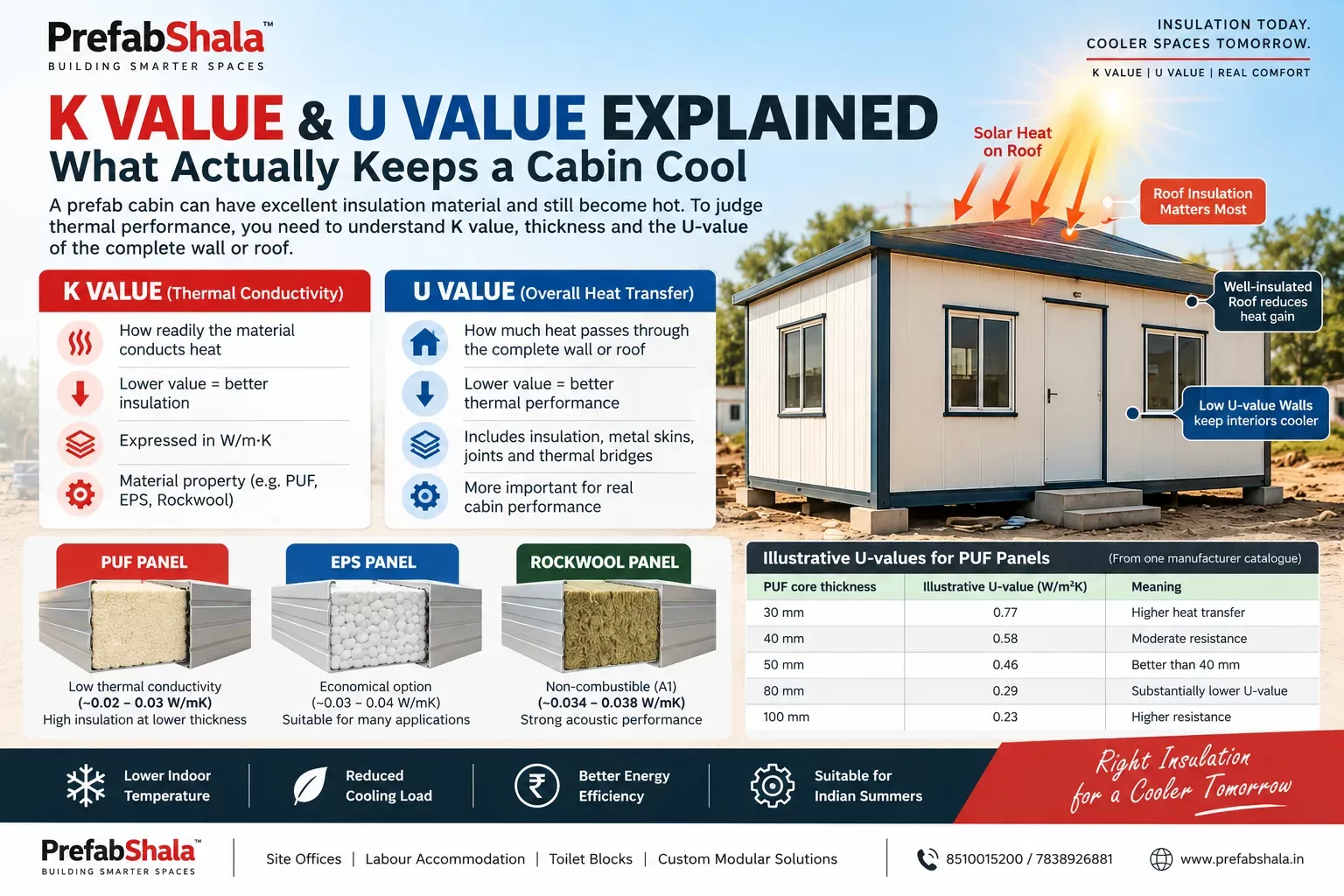
K value, commonly used in Indian construction discussions, refers to thermal conductivity: how readily heat passes through the insulation material. Lower conductivity means greater resistance to heat flow.
Thermal conductivity is normally expressed in W/m·K. It is a material property, so it should not be confused with the U-value of a complete wall or roof assembly.
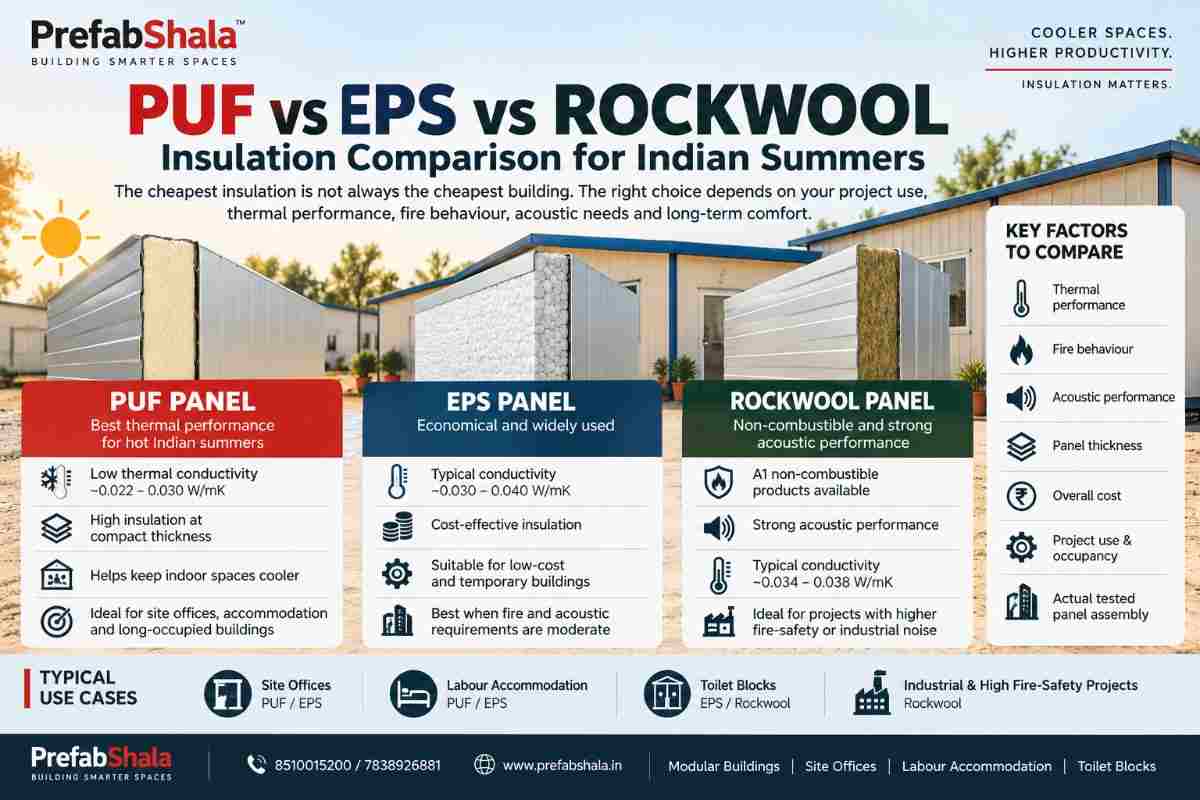
Technical PUF panel documents can report thermal conductivity around 0.02–0.03 W/mK depending on product and test condition; a BMTPC appraisal reported 0.026 W/mK at 50°C for a tested PUF sandwich panel.
What is U value and why does it matter more for a cabin?
U-value describes heat transfer through a complete building element, such as a wall or roof. A lower U-value means less heat flow through that assembly for a given temperature difference.
U-value includes more than the insulation core. Panel thickness, metal skins, joints, thermal bridges and surface resistances can all affect the assembly.
The U.S. Department of Energy explains that R-value is resistance to heat flow and U-value is inversely related; lower U-values indicate a more insulated envelope.
How do K value and thickness work together?
For a simple homogeneous insulation layer, thermal resistance increases as thickness increases and decreases as thermal conductivity increases; a simplified relation is R ≈ thickness ÷ conductivity.
If a 50 mm layer has λ = 0.025 W/mK, its idealised insulation-layer resistance is about 2.0 m²K/W. At 100 mm, it is about 4.0 m²K/W.
The real wall assembly will differ because it includes skins, joints and thermal bridges. Ask for K/λ, thickness and the tested or calculated U-value of the actual panel system.
What U-value should a prefab cabin have?
There is no single U-value that fits every prefab cabin; the target depends on climate, occupancy, air-conditioning strategy, roof exposure, windows and applicable project requirements.
For Indian summer conditions, reduce heat flow through roof and walls while controlling solar gain through openings. A low-U wall can still feel hot if the roof is poorly insulated or the cabin has large unshaded glazing.
One manufacturer catalogue gives illustrative PUF panel U-values of about 0.58 W/m²K at 40 mm, 0.46 at 50 mm and 0.29 at 80 mm. These are product-specific examples, not universal values.
PUF core thickness | Illustrative U-value from one catalogue | Meaning
30 mm | 0.77 W/m²K | Higher heat transfer
40 mm | 0.58 W/m²K | Moderate resistance
50 mm | 0.46 W/m²K | Better than 40 mm
80 mm | 0.29 W/m²K | Substantially lower U-value
100 mm | 0.23 W/m²K | Higher resistance
Why does the roof matter more than buyers expect?
The roof is directly exposed to solar radiation, so roof insulation, colour, shading, ventilation and ceiling detailing can have a large effect on indoor comfort.
A site office with good wall panels but a weak roof is a common mismatch. If the roof absorbs intense summer sun, the air-conditioning system has to remove that heat continuously.
For rooftop structures, the exposure is even more direct because the cabin sits above the existing slab without another storey shading the roof.
What should you ask a prefab vendor about K and U values?
Ask for exact thermal conductivity, panel thickness, density, test temperature and U-value of the complete panel assembly instead of accepting a single “K value” claim.
- Ask whether the stated K/λ value is measured at 10°C, 20°C, 50°C or another condition.
- Ask for panel thickness and core density together with thermal data.
- Ask whether U-value refers to the complete panel or only the insulation core.
- Ask how joints and thermal bridges are treated.
- Ask for roof and wall values separately if the systems differ.
- Ask what happens to the specification around doors, windows and service penetrations.
Does a lower U-value guarantee a cool cabin?
No. A lower U-value reduces conductive heat transfer, but indoor temperature also depends on solar gain, windows, air leakage, ventilation, occupancy, equipment and air-conditioning.
This is the difference between a material brochure and a building. A good insulation core installed badly can still produce an uncomfortable cabin.
The practical approach is to specify roof + walls + openings + joints + shading + ventilation/AC as one envelope.
K value helps judge the material; U value helps judge the assembly.
Frequently asked questions
What is the difference between K value and U value?
K value refers to thermal conductivity of a material, while U value describes heat transfer through a building element or assembly. Lower values generally mean better insulation performance.
What is a good K value for PUF?
It depends on formulation and test condition. Values around 0.02–0.03 W/mK are commonly seen in PUF product data, but use the exact certified value for the panel you are buying.
What is a good U value for a prefab cabin?
There is no universal number. A lower U-value generally means less heat transfer, but the target depends on climate, roof exposure, windows, occupancy and project requirements.
Does thicker PUF always mean better insulation?
Increasing thickness generally increases thermal resistance when material and assembly remain comparable. Joints, thermal bridges, windows and roof solar gain can still dominate.
Why is the roof so important in Delhi summer?
The roof receives direct solar radiation. A weak roof can transfer significant heat into the cabin even when wall insulation is good, increasing cooling load.
Should I ask for K value or U value from a prefab vendor?
Ask for both, plus thickness, density, test condition and the U-value of the complete wall/roof assembly. That prevents confusing a material property with whole-panel performance.
Closing takeaway
Do not approve a prefab panel from a single K-value number. Ask for thickness, density, test condition and complete wall/roof U-value, then compare the whole envelope. That is how you choose a cabin that is easier to keep comfortable in Indian summer.