BLOG 10 — INSULATION COMPARISON
Primary keyword: PUF panel vs EPS vs Rockwool
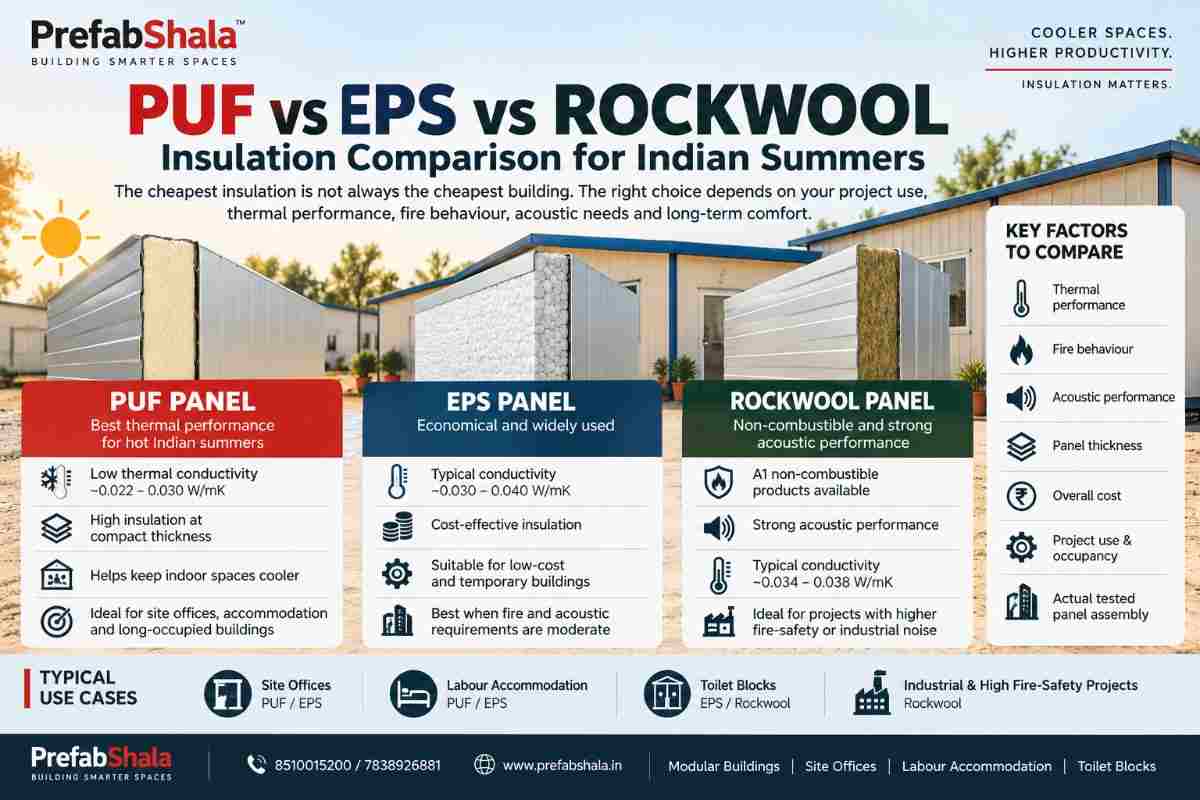
PUF Panel vs EPS vs Rockwool: Insulation Comparison for Indian Summers
The cheapest insulation is not always the cheapest building. In an Indian prefab cabin, the core affects indoor comfort, panel thickness, fire behaviour, acoustic performance and the cooling load. The right comparison starts with the actual project use, not a material name.
Quick answer
For a long-occupied prefab building in a hot climate, PUF is often the strongest thermal starting point; EPS can be economical, while Rockwool is attractive when non-combustibility and acoustic performance are priorities. Exact performance must come from the tested product and assembly.
Which insulation is best for Indian summers: PUF, EPS or Rockwool?
For a prefab building where thermal efficiency, compact panel thickness and long occupied hours matter, PUF is often the strongest starting option; EPS can be economical, while Rockwool is particularly attractive when non-combustibility and acoustic performance are high priorities.
Thermal conductivity is only one part of the decision. Exact density, thickness, panel joints, metal skins, thermal bridges, roof exposure, windows and workmanship all affect the finished building.
Published technical data illustrates the range: EPS commonly falls around 0.030–0.040 W/mK depending on density; a BMTPC appraisal reported 0.026 W/mK at 50°C for a tested PUF sandwich panel; ROCKWOOL India publishes products around 0.034–0.038 W/mK depending on product and test condition.
Factor | PUF | EPS | Rockwool
Typical conductivity | ~0.022–0.030 W/mK, product-dependent | ~0.030–0.040 W/mK | ~0.034–0.038 W/mK for cited products
Fire behaviour | System/formulation dependent | System/product dependent | A1 non-combustible products available
Acoustics | Good in many panel systems | Moderate; assembly dependent | Strong acoustic performance
Thickness efficiency | High | Moderate | Moderate
Typical priority | Heat control + compact panel | Budget insulation | Fire + acoustic priorities
Why does PUF often perform well in Delhi summer?
PUF can provide high thermal resistance at relatively low thickness because its thermal conductivity is lower than many common insulation materials.
That does not mean a 50 mm PUF wall automatically makes a cabin cool. A dark roof, large unshaded glass area, unsealed joints and exposed metal thermal bridges can still push indoor temperature up.
For a continuously occupied site office, the roof deserves as much attention as the walls. In a 45°C summer environment, roof solar gain can dominate cooling load if the assembly is poorly designed.
When should you choose EPS instead?
Choose EPS when cost and conventional availability are important and the project does not demand the specific fire or thickness advantages of another core.
EPS conductivity varies with density, so comparing “EPS” to “PUF” without specifying density is not meaningful.
EUMEPS technical guidance lists roughly 0.030–0.040 W/mK across EPS products.
For a low-cost temporary building with moderate occupancy, EPS can be sensible if the panel system, moisture protection and fire requirements are acceptable for the project.
When is Rockwool the better choice?
Rockwool becomes especially attractive when non-combustibility, fire performance and acoustic control are more important than achieving the lowest possible thermal conductivity.
ROCKWOOL India lists Hardrock products with Euroclass A1 non-combustible classification and thermal conductivity around 0.037–0.038 W/mK at 20°C. Other stone-wool products are also used for acoustic and high-temperature applications.
For an office next to heavy industrial activity or a project with a higher fire-safety priority, Rockwool can justify additional material and installation cost. Check the exact tested wall/roof assembly.
What does insulation cost per sq ft?
For early prefab budgeting, insulation choice can shift the panel rate materially; use an indicative finished-building range rather than treating the core material price as the total project cost.
A practical planning allowance for a basic-to-higher-quality insulated prefab building can be around ₹2,000–₹2,600 per sq ft for a site-office/building package. For 500 sq ft, that is roughly ₹10–₹13 lakh delivered and erected within NCR.
This is an industry planning range, not a PrefabShala quotation. Structure, floor, openings, electrical work, quantity and transport can move the final figure.
500 sq ft case | Indicative rate | Planning total
Basic insulated package | ₹2,000/sq ft | ₹10 lakh
Higher-spec package | ₹2,600/sq ft | ₹13 lakh
What is the honest trade-off between PUF, EPS and Rockwool?
There is no universal winner: PUF prioritises thermal performance per thickness, EPS can prioritise economy, and Rockwool can prioritise fire and acoustic performance.
- PUF — strong choice when occupied comfort and compact construction matter; verify exact fire classification of the complete assembly.
- EPS — useful for cost-sensitive applications; specify density and protect the system properly.
- Rockwool — useful when non-combustibility and acoustic performance matter; installation can be more demanding.
- All three — require good joints, flashing, roof design and workmanship. Insulation cannot compensate for a leaking or thermally bridged envelope.
Frequently asked questions
Which is better for a prefab cabin, PUF or EPS?
PUF is often the stronger choice for long-occupied cabins because it can provide lower thermal conductivity at similar thickness. EPS can be attractive when initial cost is the priority.
Is Rockwool cooler than PUF?
Not necessarily. Thermal conductivity depends on the exact product and test condition. Rockwool's main advantage can be non-combustibility and acoustic performance rather than the lowest thermal conductivity.
What is the thermal conductivity of PUF panels?
It varies by formulation and test condition. Indian technical documents show values around 0.026 W/mK for a tested PUF panel at 50°C. Use the exact certified value for the panel being purchased.
Is EPS fire resistant?
Do not treat EPS as universally fire resistant. Fire behaviour depends on formulation, density, facing and the complete tested assembly. Specify the required fire performance.
Does thicker insulation always make a cabin cooler?
More thickness generally increases resistance to heat flow, but roof exposure, windows, joints, thermal bridges, air leakage and shading can dominate final indoor temperature.
Which insulation should I use in Delhi NCR?
For an occupied prefab office, PUF is a strong thermal starting point. Consider Rockwool where fire/acoustic priorities are high and EPS where budget is dominant, subject to project requirements.
Closing takeaway
Choose the core after deciding the building's heat, fire, acoustic and budget priorities. Compare PUF, EPS and Rockwool on a like-for-like BOQ using exact thickness, density and tested performance.